🧠 The Power of Mental Models: Thinking Better in a Complex World
We often say “think outside the box”, but most of us never stop to ask — what is this box we’re thinking inside of?
That box is built from our mental models — the invisible frameworks that shape how we see, decide, and act.
🔍 What is a Mental Model?
A mental model is simply your mind’s map of how something works.
It’s the shortcut your brain uses to interpret situations and make decisions without starting from scratch every time.
We all have mental models — about leadership, money, relationships, and even success. The more accurate and diverse your models, the smarter your decisions become.
As Charlie Munger says: “You must have a latticework of mental models — because the world isn’t simple.”
💡 Why They Matter
Mental models help you:
- Simplify complexity
- Make faster and better decisions
- Avoid common cognitive traps
- Connect ideas across disciplines
Leaders and innovators who think in models see patterns others miss.
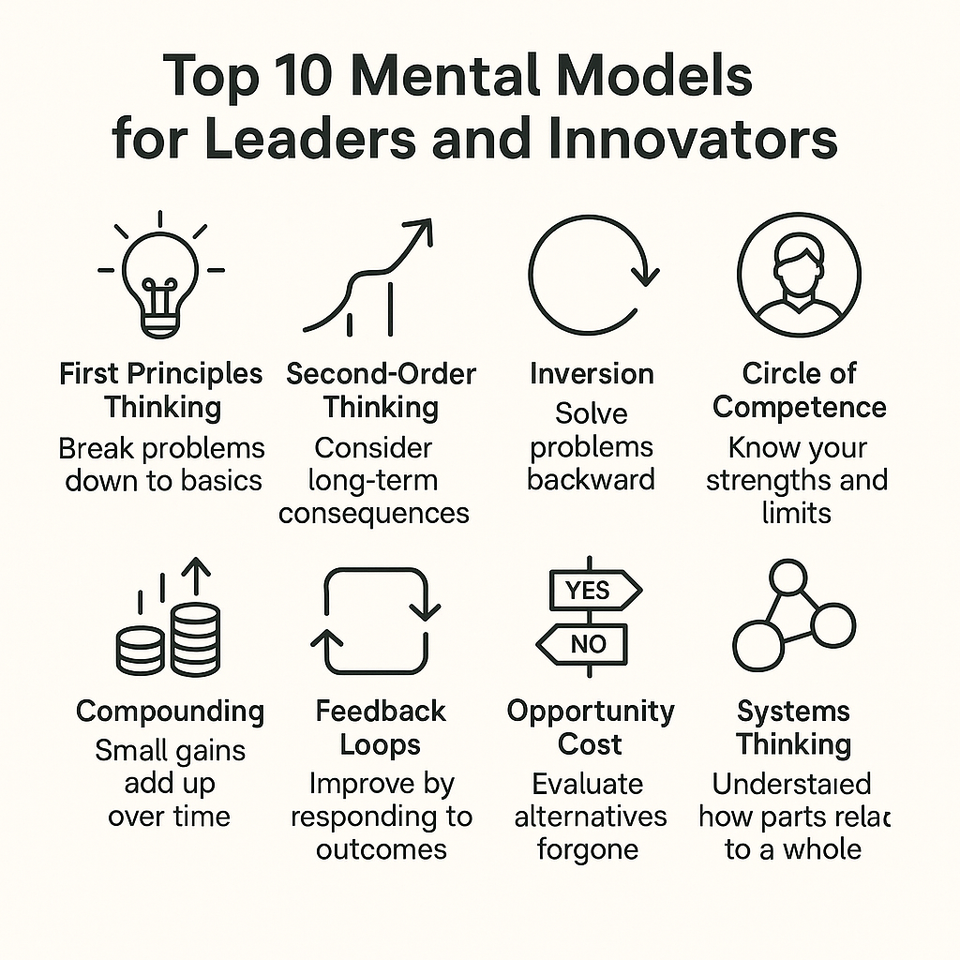
🧩 10 Mental Models Every Leader Should Know
- First Principles Thinking – Break problems down to the basics instead of copying existing solutions.
- Second-Order Thinking – Look beyond immediate effects; ask, “And then what?”
- Inversion – Solve problems backward: “What would guarantee failure?”
- Circle of Competence – Know what you know (and what you don’t).
- Pareto Principle (80/20 Rule) – Focus on the 20% that drives 80% of results.
- Compounding – Small daily habits create massive long-term results.
- Feedback Loops – Systems improve when outputs inform inputs.
- Opportunity Cost – Every yes is a no to something else.
- Systems Thinking – Everything is connected; optimize the whole, not parts.
- Probabilistic Thinking – Make decisions by weighing likelihoods, not certainties.
🚀 How to Build Better Mental Models
- Read across disciplines – science, psychology, economics, history.
- Reflect regularly – after decisions, ask: What model did I use?
- Upgrade your models – discard outdated assumptions.
- Combine models – innovation happens at the intersection of ideas.
🌱 Final Thought
The smartest people don’t just know more — they think better.
They collect, refine, and apply mental models like tools in a craftsman’s kit.
The next time you face a hard problem, don’t ask “what should I do?”
Ask — “What mental model applies here?”

Comments ()