The Hidden Map of Bias: From Brain to AI
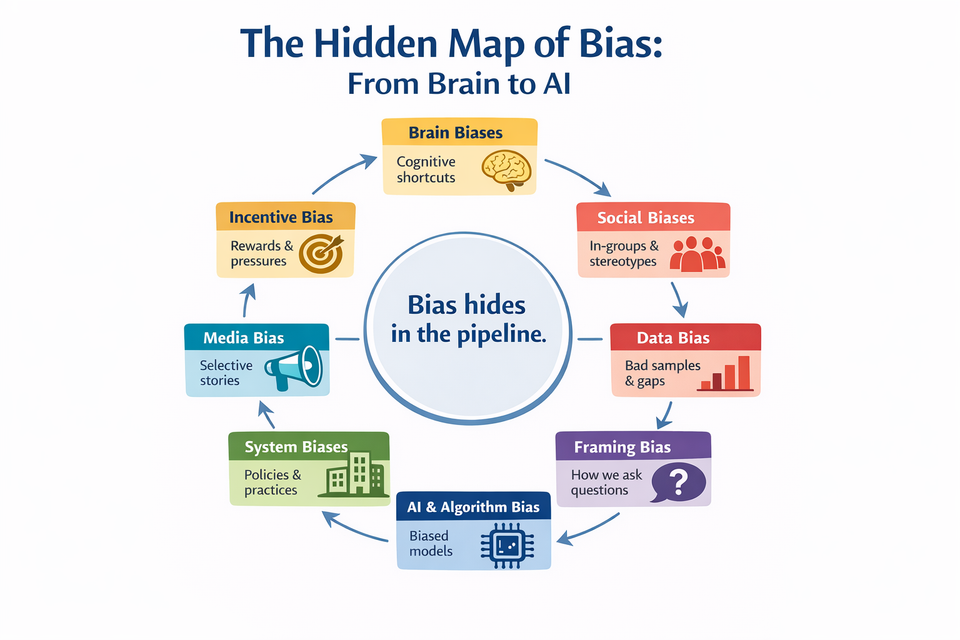
Where Bias Hides: 8 Places It Sneaks Into Our Decisions
When people hear the word bias, they often imagine a single thing: a person being unfair.
But bias is bigger than that.
Bias can live in our thinking, in our habits, in the data we collect, and even in the systems we build. That’s why good people can still make biased decisions—without intending to.
If we want fair outcomes (in workplaces, schools, society, and AI), the first step is simple: know where bias hides.
Here are 8 common places bias quietly enters our world.
1) In our brains (cognitive bias)
Our brain uses shortcuts to make fast decisions. These shortcuts help us survive and move quickly—but they can also distort reality.
Examples:
- Confirmation bias: We search for proof we’re already right.
- Availability bias: We think something is common because we recently saw it online.
- Halo effect: One good trait makes us assume everything else is good.
What helps: pause, ask “What evidence would prove me wrong?”
2) In our social world (implicit and group bias)
We’re influenced by our upbringing, culture, and social circles. Sometimes we favor what feels familiar.
Examples:
- In-group bias: We trust “our people” more.
- Authority bias: We assume seniors are always correct.
- Stereotypes: We assign traits to a person based on group identity.
What helps: structured decisions (rubrics, checklists), not gut feelings.
3) In the data we collect (data bias)
Data feels objective, but it is often incomplete or uneven.
Examples:
- Sampling bias: Data represents only one type of user (e.g., urban, English-speaking).
- Historical bias: Past unfairness gets repeated (e.g., old hiring trends).
- Measurement bias: We measure the wrong thing because it’s easier to measure.
What helps: ask “Who is missing from this dataset?”
4) In the questions we ask (framing bias)
Even before decisions happen, bias enters through wording.
Example:
- “How do we reduce risk?” vs “How do we maximize opportunity?”
Same situation, different mindset, different outcome.
What helps: rewrite your question in 2–3 different ways.
5) In tools and algorithms (AI bias)
AI doesn’t “create” bias out of nowhere. It learns patterns from humans and data.
Bias can enter through:
- training data
- labels (“what counts as good?”)
- optimization goals (accuracy vs fairness)
- thresholds (who gets approved vs rejected)
- feedback loops (model shapes behavior, behavior reshapes data)
What helps: evaluate outcomes across different groups, not just overall accuracy.
6) In systems and policies (institutional bias)
Sometimes bias is not personal—it is structural.
Examples:
- Promotions based on visibility instead of impact
- Hiring that relies heavily on referrals
- Rules that assume everyone has the same resources
What helps: audit processes, not people. Fix the system.
7) In media and information (information bias)
What we see repeatedly shapes what we believe.
Examples:
- Selection bias: some topics get covered more than others
- Narrative bias: simple stories win over complex truth
- Agenda bias: what media chooses to highlight becomes “important”
What helps: diversify sources and slow down before forming opinions.
8) In incentives (reward bias)
People follow incentives. If incentives are biased, outcomes will be biased too.
Example:
If only “fast delivery” is rewarded, teams may ignore “quality” and “inclusion.”
What helps: balance reward systems—measure what truly matters.
A simple 4-question bias detector
Next time you make a decision, ask:
- Who is missing from the conversation or data?
- What definition of success are we using—and who might it disadvantage?
- What are we measuring because it’s easy, not because it’s right?
- Who benefits if we keep doing it the same way?
Bias reduces when awareness increases.
Not because people become perfect, but because decisions become better.
Closing (spiritual / reflective)
A fair mind is a quiet mind. When we reduce ego, impatience, and assumptions, our judgement becomes cleaner. And when judgement becomes cleaner, our actions become kinder—without effort.

Comments ()