Metacognition: The Skill That Upgrades Your Learning, Career, and Decisions
Everyone thinks.
Students think while studying.
Professionals think while solving problems.
Founders think while making decisions under uncertainty.
But there’s a higher-level skill that separates fast growth from slow growth:
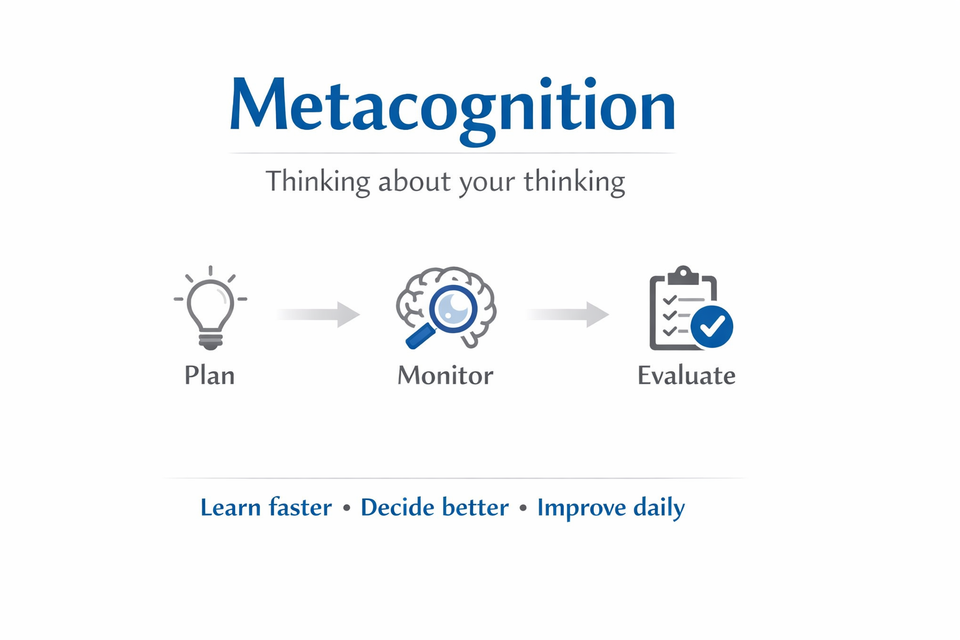
Metacognition — thinking about your thinking.
It’s the ability to notice what’s happening in your mind, and then guide it intentionally.
Why metacognition matters (for everyone)
For students: It helps you study smarter, not longer.
For professionals: It reduces mistakes and improves execution quality.
For founders: It improves judgment when the stakes are high and clarity is low.
Metacognition turns your brain from a “random engine” into a “guided system.”
The 2 parts of metacognition
1) Knowing your mind (Awareness)
This is noticing patterns like:
- “I understand better when I solve problems than when I only watch videos.”
- “I get distracted when I keep notifications on.”
- “I rush at the end and make silly errors.”
- “I avoid hard tasks and stay in comfort work.”
2) Managing your mind (Control)
This is the ability to adjust:
- switch strategy,
- slow down,
- ask better questions,
- take a break before reacting,
- review what worked and improve next time.
What metacognition looks like in real life
If you’re a student:
- “Do I actually understand this, or can I only recognize it?”
- “Can I explain it in my own words?”
- “Am I revising, or am I just re-reading?”
If you’re a working professional:
- “Am I solving the right problem, or just the urgent one?”
- “What assumption am I making?”
- “What would a simpler solution look like?”
If you’re a founder:
- “Is this decision driven by data or by fear?”
- “What would change my mind?”
- “What is the real constraint — money, people, time, or focus?”
A simple 5-minute metacognition habit (works for all)
1 minute before you start
Ask:
- What’s the outcome I want?
- What’s the best strategy to achieve it?
- What might derail me?
2 minutes while doing the task (midway check)
Ask:
- Am I making real progress?
- Do I understand, or am I just moving fast?
- Should I continue, change approach, or pause?
2 minutes after finishing
Ask:
- What worked today?
- What didn’t work?
- One improvement for next time?
This is basically “debugging your mind” like you debug code.
Common traps metacognition helps you avoid
- Overconfidence: “I know it” → but you can’t explain it.
- Busy work: doing many tasks without meaningful output.
- Emotional decisions: reacting quickly instead of responding wisely.
- Wrong priorities: solving symptoms instead of root causes.
The core idea
Metacognition gives you an inner dashboard:
- You notice your thinking,
- you correct course sooner,
- and you improve faster.
You don’t need more hours.
You need better awareness inside the hours you already have.
Closing
Your life is shaped by your decisions.
Your decisions are shaped by your thinking.
And your thinking improves when you learn to observe it.
Don’t just think. Learn to watch how you think.
That is metacognition.

Comments ()