Don't Just Write Words. Write Music.
Sometimes, inspiration arrives from the most unexpected places.
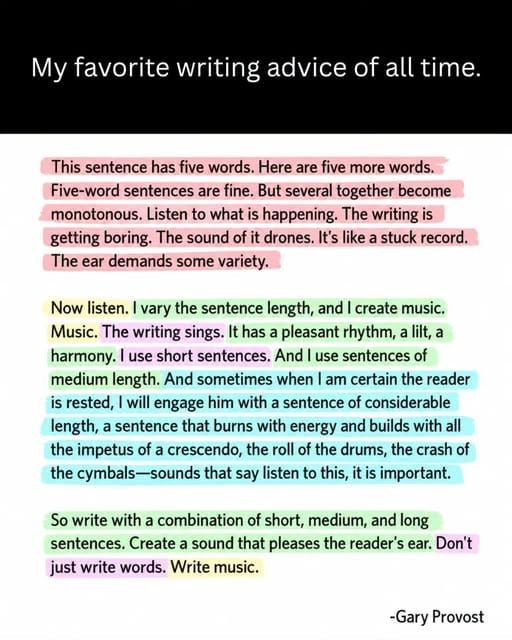
A few days ago, I was scrolling through WhatsApp Status updates when one shared by my friend Ashish Sinha caught my attention. It wasn't a quote or a motivational one-liner. It was a passage by Gary Provost.
I read it once.
Then I read it again.
And then, slowly.
What looked like a simple lesson on sentence length turned out to be a masterclass in communication.
It wasn't really about writing.
It was about rhythm.
The passage begins with a series of short sentences.
This sentence has five words. Here are five more words. Five-word sentences are fine...
Nothing is technically wrong with those sentences.
They are clear.
They are correct.
Yet after a few lines, something interesting happens.
You begin to feel tired.
The writing becomes predictable. Your brain starts anticipating the next sentence because every sentence sounds the same. The message is still there, but the music is gone.
Then everything changes.
The author begins to vary the sentence lengths. Some are short. Others are medium. Then comes a long sentence that gathers momentum, carries multiple ideas together, and lands with remarkable impact. Suddenly, the writing has rhythm. It breathes. It sings.
That's the lesson.
Writing Is More Than Words
Many people believe great writing comes from using difficult words or an impressive vocabulary.
I don't think so.
Great writing comes from making the reader feel something.
Sometimes a short sentence is enough.
It stops the reader.
It emphasizes a point.
It creates silence.
At other times, an idea deserves space to unfold naturally, allowing one thought to flow into another until the reader reaches the conclusion almost effortlessly.
The beauty lies in knowing when to do each.
This Lesson Extends Beyond Writing
The more I reflected on it, the more I realized this isn't just about writing.
It's about communication.
A speaker who talks at the same pace loses the audience.
A presentation where every slide looks identical becomes forgettable.
A movie with nonstop action becomes exhausting.
Even music needs moments of silence.
Life itself follows rhythm.
We work.
We rest.
We struggle.
We celebrate.
Nature alternates between day and night, summer and winter, activity and stillness.
Everything meaningful has rhythm.
As Engineers, We Should Learn This Too
As software engineers, we spend years learning how to write clean, maintainable code.
But we also write emails.
Documentation.
Design proposals.
Technical blogs.
Conference talks.
Performance reviews.
Our ideas don't create value unless others can understand them.
Good communication is a multiplier.
The better we communicate, the greater the impact of our work.
My Takeaway
Gary Provost wasn't simply teaching us how to write.
He was teaching us how to keep people engaged.
Writing is not about filling a page with words.
It's about guiding someone's attention.
Creating pauses.
Building anticipation.
Delivering impact.
In other words...
Don't just write words.
Write music.
Acknowledgment: This reflection was inspired by a brilliant passage written by Gary Provost, which I discovered through a WhatsApp Status shared by my friend Ashish Sinha. Sometimes, the most valuable lessons come from the people around us.

Comments ()