Beyond WIMP: Why the Next UI Won’t Be Windows, Icons, Menus, and Pointers
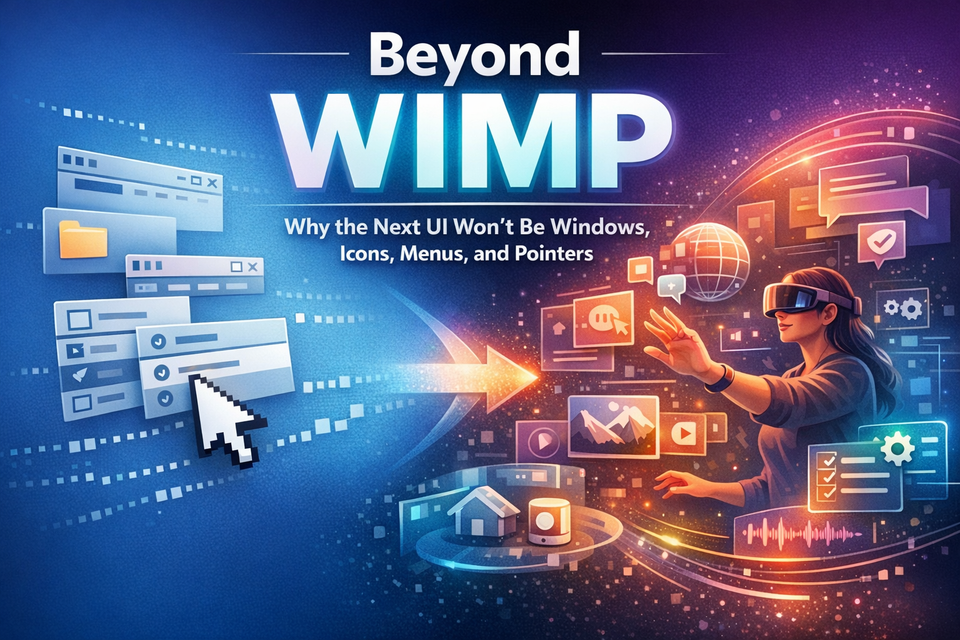
For most of our lives, using a computer has meant the same routine:
Open a window.
Click an icon.
Navigate a menu.
Move a pointer.
This is the WIMP model — Windows, Icons, Menus, and Pointers — a design approach born in the era of Xerox PARC and later popularized by personal computers.
It shaped how we work, learn, design, build, and communicate.
But something is changing.
Not because WIMP failed — it succeeded brilliantly — but because the world it was designed for no longer matches the world we live in today.
WIMP was built for a different world
WIMP assumed a few things:
- You’re sitting at a desk in front of a single screen
- You’re using mouse + keyboard for precise input
- Work happens inside apps
- You execute tasks through a series of small, explicit steps
That made perfect sense in the desktop era.
WIMP gave us structure and predictability:
- you can see what’s open,
- you can click what you want,
- you can undo and redo,
- you can learn by exploring menus.
For many professional workflows — coding, EDA tools, CAD, spreadsheets — WIMP is still incredibly efficient.
But now WIMP is feeling heavy
Today, we don’t just use computers at desks.
We use devices everywhere:
- phones, tablets, watches, TVs
- cars and smart homes
- AR/VR headsets
- voice assistants
And our expectations have changed.
We don’t want to translate a goal into 15 clicks across three apps.
We want to say what we want — and get it done.
In the WIMP world, you do this:
Goal → convert to steps → execute steps → adjust → repeat
In the new world, people want:
Goal → intent understood → work executed
That shift is not cosmetic. It’s foundational.
The post-WIMP era: computing becomes intent-first
The next generation of interfaces is moving from navigation to conversation + action.
Instead of asking:
“Which menu has this feature?”
We’ll ask:
“Can you do this for me?”
Examples we already see today:
- “Summarize this document and give action items.”
- “Draft a reply to this email in my tone.”
- “Remove the background from this photo and enhance the lighting.”
- “Plan a 5-day trip that fits my budget and preferences.”
This is intent-first computing — where the interface becomes less about where buttons are, and more about what outcome you want.
What replaces WIMP? A blend of new interaction models
Post-WIMP is not one single thing. It’s a stack of shifts happening together:
1) Conversational + multimodal interaction
Language becomes a primary interface — but not alone.
You might:
- speak a request,
- highlight text,
- point at an image,
- show the camera,
- and the system understands it as one combined instruction.
It’s not “click or type.”
It’s communicate.
2) Direct manipulation without the “pointer”
Touch, pen, gestures, gaze and hand tracking reduce the need for a mouse.
In many contexts, the “pointer” becomes optional.
You don’t aim like a sniper. You interact like a human.
3) Spatial computing: content moves into your environment
In AR/VR, windows don’t feel natural anymore.
Instead:
- information becomes panels around you,
- tools can sit where you need them,
- your room becomes the workspace.
It’s still UI — but it’s not WIMP.
4) Agents: software that can execute workflows
This is the big one.
Instead of doing every step manually, you can delegate:
- “Collect updates from my calendar, messages, and tasks. Make a weekly summary.”
- “Track this metric and alert me when it changes.”
- “Generate a first draft and I’ll review.”
Software becomes less like a set of buttons and more like a teammate.
WIMP isn’t dying — it’s becoming “Pro Mode”
Let’s be honest: WIMP still wins in precision-heavy work.
If you’re building chips, writing code, designing a PCB, or editing complex timelines — WIMP is hard to beat.
So the future is not “no windows.”
It’s this:
- Everyday computing becomes post-WIMP by default
- Precision creation keeps WIMP as a specialized layer
WIMP won’t vanish.
It will move from “default” to “advanced toolset.”
The real shift: from tools to partners
At a deeper level, this transition changes our relationship with computers.
WIMP assumes:
The computer is a tool. You operate it.
Post-WIMP assumes:
The computer is a collaborator. You direct it.
That brings new questions:
- How much control should we delegate?
- How do we verify results?
- What about privacy and trust?
- How do we prevent mistakes at scale?
The UI shift is easy.
The responsibility shift is the real challenge.
Closing thought
WIMP defined the last 50 years of computing.
The next era will be defined by systems that understand:
- intent,
- context,
- multimodal input,
- and real-world workflows.
We are not just leaving behind an old interface style.
We are moving toward a new idea:
The best interface is the one that disappears — and still gets the work done.

Comments ()